
They weren't up for a windfall even after the trophy but life was certain to get a lot better as some sponsors and state governments stepped up to lift them financially.

The win helped Real Kashmir climb to the sixth spot in the standings.

Mohammad Yousuf Katari, an Over Ground Worker (OGW), has been arrested for providing logistical support to terrorists involved in the Pahalgam attack. He met the terrorists multiple times and provided them with a crucial piece of evidence that led to his capture.
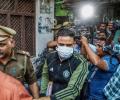
Radical Islamist networks are deliberately targeting Muslim youths embedded within the country's professional and academic ecosystems, leveraging their skills, mobility, and digital reach to quietly strengthen operational capabilities. This trend highlights a dangerous evolution in terror recruitment -- one that exploits ideological faultlines, online echo chambers and transnational radical Islamist influences to attract individuals who outwardly embody India's modern and aspirational narrative, points out Dr Kanchan Lakshman.
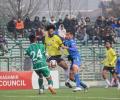
Despite playing with a man less for virtually the entire match, Real Kashmir's defence stood resilient, managing to hold off Sreenidi Deccan's late surges to ensure the points were shared.

Season 3 belongs to Jaideep Ahlawat who, despite the not so well-etched character, owns Rukma and gives the confrontation with Srikant Tiwari the missing edge of the earlier two seasons, observes Saisuresh Sivaswamy.

Sankarshan Thakur, editor of The Telegraph whose prowess with words added that extra edge to his analyses and ground reports, died at a Gurgaon hospital on Monday after prolonged illness. He was 63.

The National Stock Exchange (NSE) faces around 170 million cyberattacks daily, requiring a dedicated team of "cyber warriors" to work around the clock to ensure uninterrupted operations. The NSE recorded its highest-ever 40 crore (400 million) cyberattacks in a single day during 'Operation Sindoor', designed as a DDoS simulation. However, attackers failed to cause any damage due to the coordinated efforts of men, machines, and advanced technology.

The IDF admitted that the map "fails to precisely depict borders".
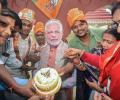
An e-auction of over 1,300 items gifted to Prime Minister Narendra Modi has begun, featuring items such as a statue of Goddess Bhavani, an Ayodhya Ram Temple model, and sports memorabilia from the 2024 Paralympic Games. Proceeds will go to the Namami Gange project.
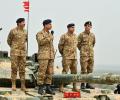
Pakistan Army Chief Asim Munir has described terrorism in Jammu and Kashmir as a 'legitimate struggle', saying his country would always stand by the people of Kashmir in their struggle.
JeM commander Ilyas Kashmiri also said that the Pakistan Army and the jihadis have become one after 25 years of his outfit's struggle.

Punjab Police arrested three men from Jammu and Kashmir, uncovering a Jaish-e-Mohammad (JeM) linked terror module in connection with the murder of a cab driver. The accused confessed to the crime and the victim's body and the weapon used were recovered.
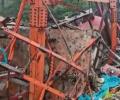
Six people died after a cable wire snapped on a cargo ropeway at Pavagadh Hill in Gujarat. The victims included ropeway operators and others transporting materials to the hilltop Mahakalika Temple.
India has to fill in all the critical gaps in missiles, ammunition, sensors and stockpile in the fastest possible manner, focusing on the critical instruments that worked this time, asserts Shekhar Gupta.
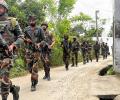
Security forces in the Jammu region are maintaining a strong vigil and conducting operations to track down 40 to 50 terrorists active in the area. Multi-tier security measures, including anti-drone strategies and intensified night operations, are in place.
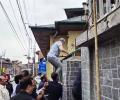
The delayed timing of J&K Lieutenant Governor Manoj Sinha's admission has more to do with deflecting the thrust of the Opposition attack on the prime minister and Union home minister during the monsoon session of Parliament, points out Mohammad Sayeed Malik, the distinguished commentator on Kashmir affairs.

The encounter broke out when a joint search party of the army and police launched a search operation, based on a specific intelligence, in remote Bihali area of Basantgarh in the district this morning. Reinforcements have been rushed in and a massive search operation is going on despite bad weather.
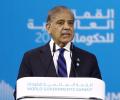
He conveyed this during a telephonic conversation with US Secretary of State Marco Rubio, according to a statement posted by the state-run Pakistan Television on X.
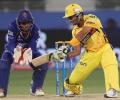
Mithun Manhas: Street-Smart cricketer, who was always at the right place at right time

Prime Minister Narendra Modi on Monday presented India's strong stance against terrorism, calling out the 'some countries' for their open support of terrorism and reaffirming that such 'double standards' are not acceptable.

According to the DRDO chairman, the BrahMos missile, primarily launched from Sukhoi Mk 1, was used during the offensive phase.

10 Heroes of the 1965 War which ended on September 23 60 years ago.
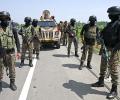
India needs to be technologically and militarily prepared to defend itself from both Pakistan and China, alerts Ramesh Menon.

'And then the people who call themselves great nationalists, I can bet you that 99 per cent of them are dodging taxes, have sent their kids to America, or are doing everything to make sure that what goes on in this country doesn't affect their personal wealth or their whatever bull*&$%.'

A UN Security Council report states that The Resistance Front (TRF) claimed responsibility for the Pahalgam terror attack and published a photograph of the attack site. The report also cites assertions that the attack could not have happened without the support of Pakistan-based Lashkar-e-Tayyiba (LeT).
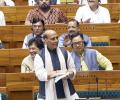
Here's a quick look at who spoke in the Lok Sabha on the first day of the Operation Sindoor debate.

Days before the deadly terror attack in Pahalgam, intelligence agencies had flagged the potential targeting of tourists especially those staying in hotels on the outskirts of Srinagar in the foothills of the Zabarwan range, officials in the know said Saturday.
It was Prime Minister Narendra Modi who picked the evocative term 'Operation Sindoor' to codename the Indian armed forces' strikes on nine terror sites in Pakistan and Pakistan-occupied Kashmir, official sources said on Wednesday.

The National Investigation Agency (NIA) has started interviewing eyewitnesses, including tourists, in connection with the deadly terrorist attack in Pahalgam, south Kashmir. The attack, carried out by terrorists from the Pakistan-based Lashkar-e-Taiba (LeT), claimed the lives of 26 people on April 22. Initial investigations suggest that five to seven terrorists were involved, aided by local militants trained in Pakistan. Security forces are conducting massive operations to hunt down the terrorists in the dense jungles of the Pir Panjal range.
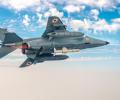
India's precision strikes using an array of weapon systems and missiles on eight key installations ranging from air defence systems to radar sites and command centres of the Pakistani military forced Islamabad to urge New Delhi to end the hostilities, the sources said.
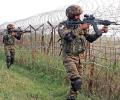
Pakistan troops have violated the ceasefire agreement for the 11th consecutive night, firing on Indian posts along the Line of Control (LoC) in Jammu and Kashmir. The firing began in Kupwara and Baramulla districts and spread to other sectors, including Poonch, Rajouri, Mendhar, Naushera, Sunderbani, and Akhnoor. The Indian Army responded promptly and proportionately. The ceasefire violation comes despite a recent phone call between the Directors General of Military Operations (DGMOs) of India and Pakistan on April 29. This marks the latest escalation of tensions between the two countries, following a terror attack in Pahalgam in April.
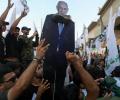
The ministry of external affairs said in a statement that the Indian embassy remains in touch with the community with a view to extend all feasible assistance.

The shocking scenes of physical and psychological trauma unfolded on a massive scale as search and rescue operations were underway, digging out mud-buried bodies and rescuing the injured trapped in slush and rocks after flash floods triggered by a cloudburst devastated Chositi village in Jammu and Kashmir's Kishtwar district on Thursday.
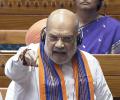
'Anyone they don't like can be potentially arrested and thrown in jail for 30 days to induce regime change.'

Operation Sindoor is not just a name but India's latest policy against terror as it has set a new standard, a 'new normal' in counter-terrorism measures, Prime Minister Minister Narendra Modi asserted on Monday.

Sheikh Sajjad Gul, the head of Lashkar-e-Taiba proxy The Resistance Front (TRF), has been identified as the mastermind behind the Pahalgam terror attack that killed 26 people in April. Gul, who is based in Pakistan, has a history of planning terror attacks in Kashmir, including targeted killings, grenade attacks, and ambushes of police personnel. He was designated a terrorist by the NIA in 2022 and a reward of Rs 10 lakh was placed on his head. The TRF claimed responsibility for the Pahalgam attack, where tourists were shot at point-blank range after being asked their religion. Gul's history includes a 2002 arrest in Delhi for planning serial blasts and a subsequent 10-year prison sentence. After his release, he moved to Pakistan and became the leader of the TRF in 2019, a move orchestrated by the ISI to present a facade of an indigenous terror movement in Jammu and Kashmir.
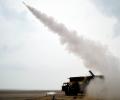
The Indian Army in the intervening night of May 8 and May 9 successfully repelled and responded to multiple drone attacks by Pakistan along the western border and the Line of Control (LoC) in Jammu and Kashmir.
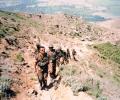
'5465 was over 17,000 feet -- our eyes were out of the sockets by the time we got to the top.' 'We had not eaten in 2-3 days and climbed in extremely difficult terrain.' 'I was there for 5-6 days, but had to be evacuated because I started vomiting blood.'

He also said that his country would continue to talk about the Kashmir issue "through channels that are acceptable" and prayed that "the issue is amicably resolved".
